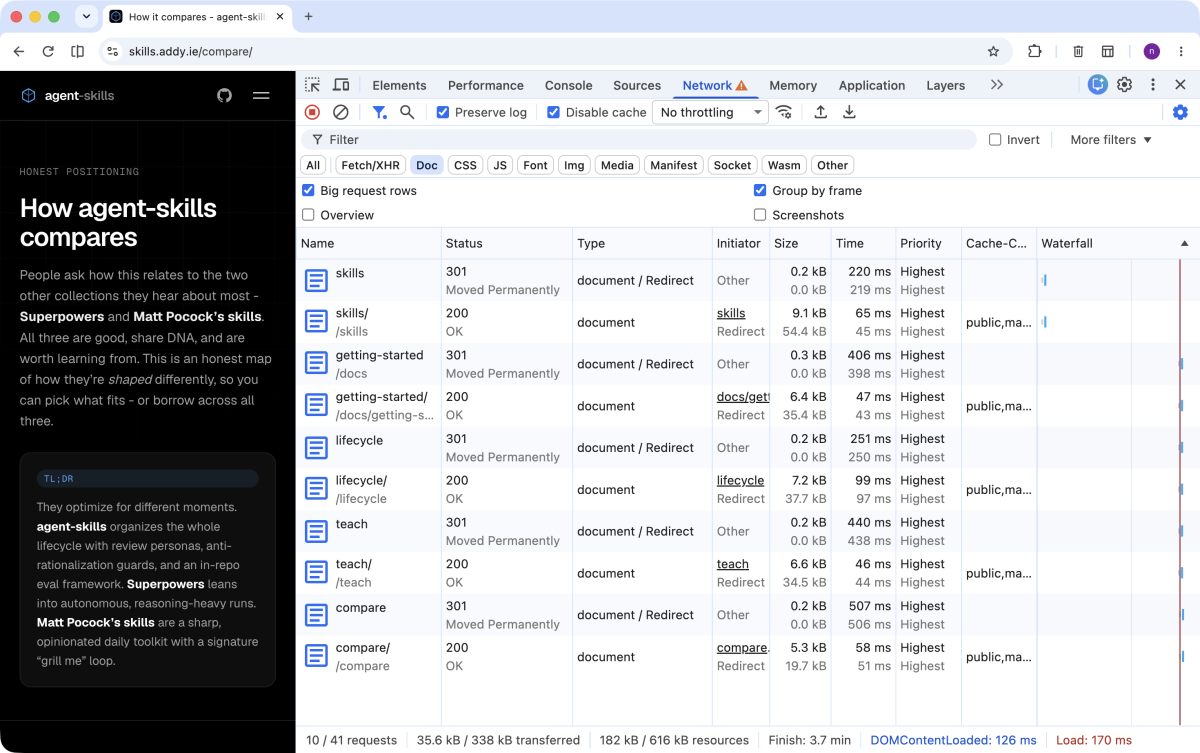
I was reviewing [skills.addy.ie](https://skills.addy.ie), the site for the Agent Skills project I've been collaborating on, and I was doing it the way I almost always do: with DevTools open. It's an occupational habit; I open them out of routine to look for things to improve, not because anything felt slow. And that's how I caught it, almost in passing, in the Network panel: **every internal link I clicked triggered a 301 redirect** before the page loaded. Not one, not on one specific page: all of them. `/skills`, `/lifecycle`, `/compare`, `/docs/getting-started`... all responded first with a 301 to their trailing-slash version.
It looks harmless, but a 301 on every navigation is a whole round trip that visitors pay before the page even starts downloading. I ended up opening a [PR to the repository](https://github.com/addyosmani/skills.addy.ie/pull/1) to fix it. Let's look at what I found, why it happened, and why the obvious fix wasn't quite the right one.
## What I saw in DevTools
In the Network panel, browsing the site and clicking the menu links, the pattern repeated on every click:
```text
GET /skills 301 220 ms → /skills/
GET /skills/ 200 65 ms
GET /docs/getting-started 301 406 ms → /docs/getting-started/
GET /docs/getting-started/ 200 47 ms
GET /lifecycle 301 251 ms → /lifecycle/
GET /lifecycle/ 200 99 ms
GET /teach 301 440 ms → /teach/
GET /teach/ 200 46 ms
GET /compare 301 507 ms → /compare/
GET /compare/ 200 58 ms
```
Before the fix: each internal navigation generates a 301 Moved Permanently to the trailing-slash URL and then the real 200. The 301 for /compare takes 507 ms on its own. Enlarge image
Each navigation is two requests: first the slash-less URL, which returns a `301` with a `Location` pointing to the same URL with a trailing slash, and then the correct URL, which finally returns the `200` with the document. The server is Netlify.
Those 301s cost from **220 ms to 507 ms** per click, adding up to **1.82 seconds** of latency in redirect hops alone across a five-navigation session. And it's not time spent downloading anything useful: if I look at the breakdown of the `/compare` 301, almost all of it is `wait`, the server response time:
```text
blocked 1 ms
send 0 ms
wait 505 ms
receive 1 ms
```
With no DNS or handshake (the connection was already open and reused), the 301 is a full round trip whose only job is to answer "this page is one character further along, request it again with the slash". The real document doesn't start arriving until the second request.
## How it affects UX
A single 301 goes unnoticed. The problem is that here it happened on **every internal navigation**, so the cost isn't a one-off, it's a toll paid over and over throughout the visit. A visitor clicks a link and, before seeing anything, the browser makes a round trip to the server that doesn't paint a single pixel.
And that cost gets worse exactly where it hurts most: on high-latency networks. On a mobile connection or far from Netlify's edge, an extra round trip isn't 200 ms, it's easily 400 or 500 ms per click. And I measured this on a good connection, so it counts as one of the best cases, not the worst. Multiply it across a session of ten or fifteen navigations and we're spending seconds of accumulated waiting that add nothing.
## The first fix that came to mind
The first thing I thought, seeing that the 301 always went from `/route` to `/route/`, was the obvious one: **change the links so they already point to the trailing-slash URL**. If the link points straight to `/skills/`, there's nothing to redirect.
```html
Browse skillsBrowse skills
```
It's correct, but it's treating the symptom link by link. Before touching anything I wanted to understand why the site generated slash-less links when its canonical URL did carry one. If we patch without understanding the cause, the problem comes back the moment someone adds the next slash-less link.
## Cloning the repo and understanding the context
I cloned the repository and used Claude Code to map where the links came from and how the build was configured. The cause wasn't a stray link, but the combination of three things:
1. **Astro builds in `directory` format by default.** Each page is emitted as `//index.html`, so its canonical URL **carries a trailing slash**: `/skills/`.
2. **The internal links were written without the slash.** And most weren't stray literals but generated dynamically (the navigation data arrays, the catalog cards), which is why they weren't obvious at a glance.
3. **Netlify, by default, canonicalizes with a 301.** When you request `/skills`, the host responds with a redirect to the `/skills/` that does exist as a directory. It's the host's standard behavior for serving directory-format output.
There's one missing piece that explains why this **wasn't visible locally**: Astro's dev server, with the default `trailingSlash: 'ignore'`, serves both `/skills` and `/skills/` with a direct `200`. The redirect only shows up on the static production host. In the development environment, everything looked perfect. The bug lived exactly in the gap between how the dev server serves URLs and how Netlify does.
## The solution
The fix has two parts, and the first is the one that stops the problem from coming back.
### 1. Make the convention explicit in `astro.config.mjs`
```js
export default defineConfig({
trailingSlash: "always",
// ...
});
```
With `trailingSlash: 'always'` two good things happen: the URL convention is declared explicitly, and the **dev server starts redirecting too**. That is, the mismatch becomes reproducible locally, and any future slash-less link gets caught before it reaches production. It stops being a ghost bug that only exists in the production environment.
### 2. Add the trailing slash to every internal link
The literals are straightforward, but the ones actually generating most of the redirects were the dynamic ones, like the skill catalog cards:
```jsx
{/* ❌ Bad */}
href={`/skills/${skill.slug}`}
{/* ✅ Good */}
href={`/skills/${skill.slug}/`}
```
The same in the data arrays of `Nav.astro` and `Footer.astro`, and in the literal links across the pages. **External links and file assets** (`.svg`, `.png`, `.pptx`...) are left untouched: the trailing slash is a matter of internal routes, not files.
### An SEO caveat
Removing the 301 from internal navigation doesn't mean removing the 301 from the site, and that's how it should be. Slash-less URLs already indexed or linked from outside **will keep receiving** Netlify's 301 to their canonical version, which is exactly the correct canonicalization for SEO: a single valid URL per page, no duplicate content. What the PR fixes is the hop in **internal** navigation, which was the source of the latency paid by whoever was already inside the site.
### How to verify it
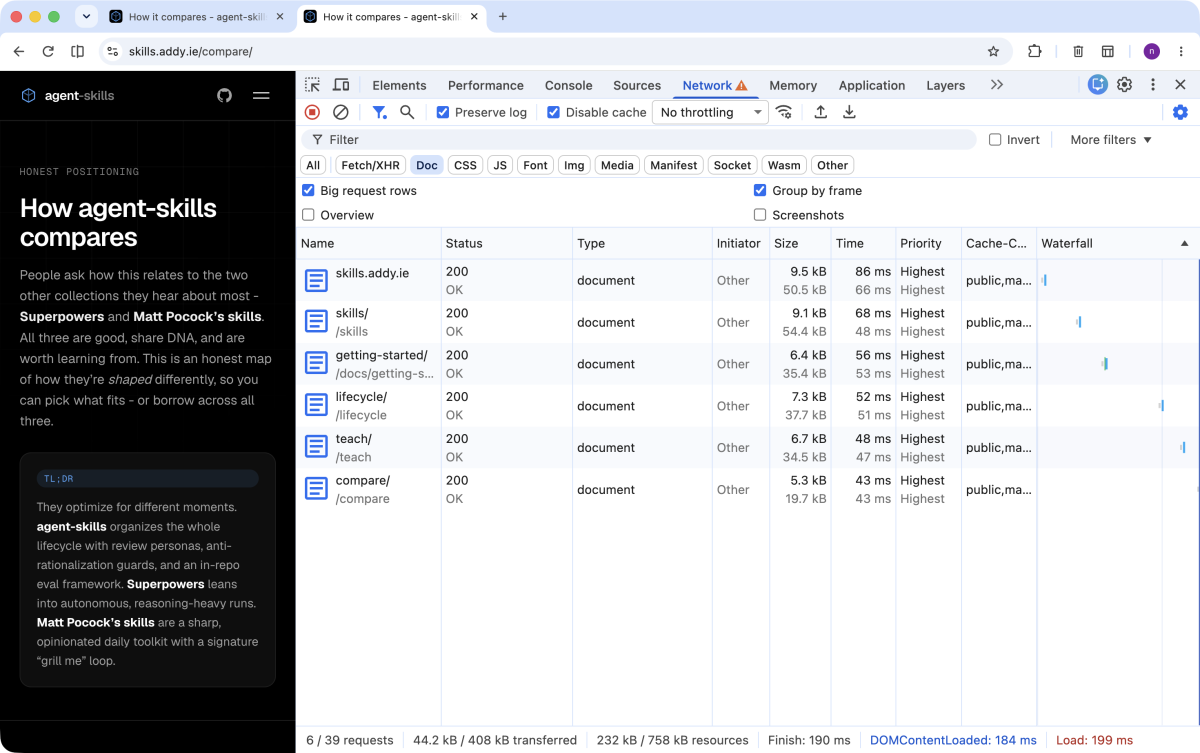
The check isn't "trust me", it's measurable. I validated before and after by capturing the Network activity in the same browsing session and comparing the two HAR files with Claude Code. After the fix, it looks like this:
```text
GET / 200 86 ms
GET /skills/ 200 68 ms
GET /docs/getting-started/ 200 56 ms
GET /lifecycle/ 200 52 ms
GET /teach/ 200 48 ms
GET /compare/ 200 43 ms
```
After the fix: the same routes return a direct 200, without a single redirect. The two requests per click become one. Enlarge image
The initial load plus the five internal navigations: six direct `200`s, **zero redirects**. The round-trip toll per click is gone.
And how do you keep it from creeping back in without eyeballing DevTools by hand? It's worth automating the watch:
- `trailingSlash: 'always'` is the first safety net: the dev server redirects, so a slash-less link shows up locally or in E2E tests before it ships.
- A lint rule or a `grep` over the built `dist` in CI that fails if a slash-less internal link appears.
- Lighthouse's _Avoid multiple page redirects_ audit flags redirect chains in production.
## What I take away
Three practical takeaways from this case:
- **The dev server can mislead you by omission.** Not because it fails, but because its defaults are more permissive than the host's. It's worth opening DevTools against the **real deployed site**, not just against `localhost`: there are problems (redirects, headers, caching) that only exist in production.
- **Trailing-slash consistency matters more than it seems.** It's not cosmetic: a mismatch between the canonical URL and the internal links is paid in a round trip per click. Pick a convention and declare it explicitly in the config, so the tooling enforces it for you.
- **Before patching the symptom, understand the cause.** Changing the links by hand would have worked today and broken with the next link someone added without a slash. `trailingSlash: 'always'` turns the rule into something the project itself enforces.
If you have an Astro site on Netlify (or any host that canonicalizes directories), open DevTools, browse around a bit, and look at the status column. If you see 301s where you expected 200s, you know where to start.